
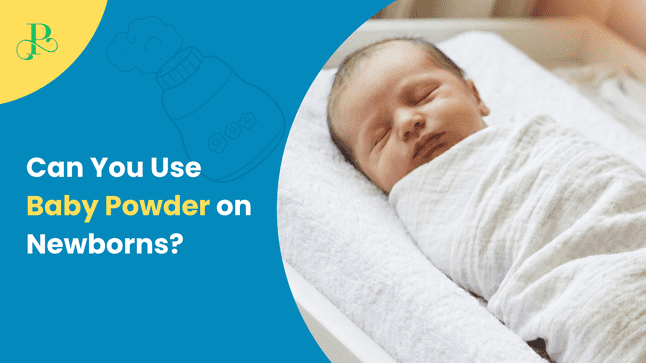
As a parent, your instinct is to protect your newborn from every possible harm. You want their skin to be soft, dry, and rash-free. For generations, the distinct scent of baby powder has been synonymous with fresh, clean babies. But in recent years, this bathroom staple has become the center of intense medical scrutiny and legal debate.
If you are holding a bottle of powder and asking, Can you use baby powder on newborns? The short answer from medical experts is “No”.
This guide explores the safety facts, the hidden risks of inhalation, and the modern alternatives that keep your baby comfortable without the worry.
Can You Use Baby Powder on Newborns?
No, you cannot use baby powder on newborns. Medical experts generally advise against using baby powder on newborns. Due to the risk of the baby inhaling fine particles, which can damage developing lungs. If you must use it, choose a talc-free option, even never use talc-free for (0 to 3 month) baby.
The traditional advice passed down from grandparents often clashes with modern medical guidelines. According to the American Academy of Pediatrics (AAP), the use of baby powder is generally not recommended for newborns and infants.
The primary concern is not just skin irritation, but inhalation. A newborn’s lungs are tiny and developing. When you shake a bottle of powder, thousands of microscopic particles are released into the air. If your baby breathes these in, it can lead to serious respiratory complications.
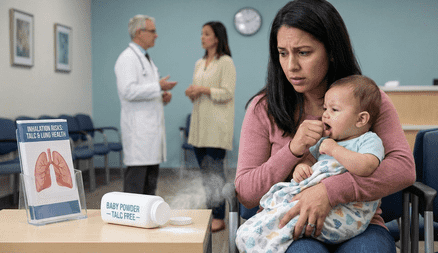
“People who are using these large amounts of baby powder, particularly around the baby’s face, run the risk of the child inhaling this very fine particulate matter into the lungs”
Dr. Joel Kahan, (a pediatrician and director of pediatrics at Syosset Hospital in New York)
While it is physically possible to use it, the consensus among US pediatricians is that the risks often outweigh the benefits, especially when safer, more effective products (like barrier creams) exist.
When Can You Use Baby Powder on a Newborn?
There is no medically safe age for using baby powder, but the risk is highest for newborns (0–3 months). Doctors suggest waiting until toddler hood or avoiding it entirely to prevent respiratory distress.
If you decide to use powder despite the recommendations. Always check expiration of baby powder before using it. There isn’t a specific age that magically eliminates risk. However, newborns (0 to 3 months) are the most vulnerable because their airways are so small and they cannot cough effectively to clear particles.
Most experts suggest waiting until the child is older (toddler age) if you must use it, but even then, caution is required. If you choose to use it on a newborn, you must strictly follow “The Hand Transfer Method”:
- Never shake the bottle directly near the baby.
- Step away from the changing table.
- Shake a small amount into the palm of your hand.
- Rub your hands together to minimize dust clouds.
- Gently pat (do not rub vigorously) onto the baby’s skin, well below the neck.
Which Baby Powder is Best for a Newborn Baby?
The best and safest option is a Talc-Free powder made from pure cornstarch. You should strictly avoid talc-based powders due to potential contamination risks. Don’t use even Talc-Free for (0 to 3 month) baby.
If you are shopping for baby powder, the ingredient list is the most critical part of the bottle. There are two main types:
Talc-Based Powder (Avoid)
Talc is a soft mineral mined from the earth. In its natural form, talc can be found close to asbestos, a known carcinogen. While cosmetic talc has been required to be asbestos-free since the 1970s, recent high-profile lawsuits and recalls (specifically involving Johnson & Johnson) have linked talc to potential cancer risks and respiratory damage.
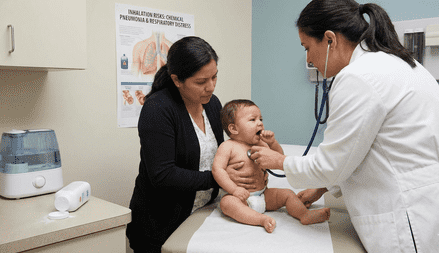
Do not use talc-based products on newborns.
Cornstarch-Based Powder (Safer, but use caution)
Most modern baby powders, including the reformulated versions from major brands, now use pure cornstarch. Cornstarch particles are larger than talc particles, making them slightly harder to inhale deeply.
Cornstarch-Based Powder is the best option if you must use powder, but it still poses an inhalation risk if a cloud of dust is created.
Look for brands labeled “Talc-Free” with ingredients like Cornstarch, Arrowroot, or Kaolin Clay. Brands like Burt’s Bees Baby Dusting Powder or Nature’s Baby Organics are popular US choices because they avoid synthetic fragrances.
When Can You Use Baby Powder on a Newborn Face?
Never Ever, Never apply baby powder to a newborn’s face. This places dust particles directly near the nose and mouth, guaranteeing inhalation and potentially causing chemical pneumonia.
There is no medical reason to put powder on a baby’s face. Doing so is considered dangerous by pediatricians. Inhalation can cause:
- Chemical pneumonia.
- Dried mucous membranes.
- Severe coughing and wheezing.
If your baby has a rash on their face (like baby acne or drool rash), powder will not help and may make it worse by clogging pores. Instead, use a gentle pediatrician-approved moisturizer or simply keep the area clean with warm water.
When Can You Use Baby Powder on a Newborn Breastfeeding?
You should not use baby powder on your chest or breasts while breastfeeding, as your baby can inhale the dust or ingest the powder while nursing.
If you apply powder to your body to prevent sweat or chafing, your newborn is pressed against that area during feeding. This presents two distinct risks:
- Inhalation: The baby’s nose is pressed against your skin, breathing in the powder.
- Ingestion: The powder can transfer to the nipple and be swallowed by the baby.
If you need to manage perspiration, use a towel or a safe, cream-based antiperspirant and wash your skin thoroughly with water before nursing.
How to Use Baby Powder for Diaper Rash?
Do not use powder for diaper rashes, specifically yeast rashes. Cornstarch can “feed” the yeast and worsen the infection. Use zinc oxide cream instead.
Parents often reach for powder to keep a diaper rash dry. However, this can backfire. While cornstarch is safer than talc, it is still a food starch. If your baby has a Candida (yeast) diaper rash. Which is very common the yeast can actually feed on the cornstarch, allowing the bacteria to thrive.
The Safer Protocol for Diaper Rash:
- Clean: Use water and a soft cloth (skip alcohol-based wipes).
- Dry: Pat the bum completely dry with a towel or let it air dry. Moisture is the enemy.
- Treat: Instead of powder, use a thick layer of zinc oxide cream or petroleum jelly. These create a waterproof barrier that heals the skin without the risk of dust.
Can We Use Baby Powder on Private Parts?
No, avoid applying powder directly to a baby’s genitals. Do not put powder directly on private parts. It can accumulate in skin folds causing irritation, and long-term use in females has been debated for potential health risks.
For decades, it was common practice to powder a baby girl’s genital area. Today, medical research suggests we stop.
Studies have investigated a potential link between long-term talc use on female genitals and ovarian cancer in adults. While the evidence is mixed and debated, the International Agency for Research on Cancer (IARC) has classified genital use of talc-based powder as “possibly carcinogenic to humans.”
For a newborn, the immediate risk is physical irritation. Powder can clump inside the folds of the labia or scrotum, causing friction and irritation rather than preventing it.
What to Use Instead of Baby Powder for Babies?
The safest alternatives to baby powder are petroleum jelly (Vaseline), zinc oxide diaper creams, or modern “liquid-to-powder” lotions that eliminate airborne dust.
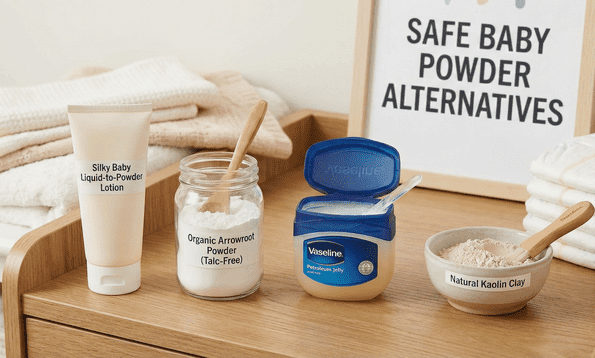
If your goal is to prevent friction and absorb moisture, there are several approved alternatives that are safer than traditional loose powders.
1. Liquid-to-Powder Lotions
This is the top innovation in baby care. These products apply like a smooth lotion but dry into a silky, powdery finish. You get the friction protection without the airborne particles.
2. Arrowroot Powder
Similar to cornstarch but often considered lighter, arrowroot is a natural starch derived from tropical plants. It is highly absorbent and talc-free.
3. Petroleum Jelly (Vaseline)
The gold standard for pediatricians. It doesn’t absorb moisture, but it repels it perfectly. It is cheap, effective, and has zero inhalation risk.
4. Kaolin Clay
A gentle, cosmetic clay often found in natural baby products. It absorbs moisture without being a food source for yeast/bacteria like cornstarch can be.
Conclusion
So, you should not use baby powder on a newborn. The risks of respiratory distress from inhalation and the potential complications with diaper rashes make it a product that is slowly fading from modern nurseries. The American Academy of Pediatrics has made it clear that “less is more” when it comes to a newborn skin.
If you love the ritual of powder, choose a talc-free, cornstarch-based product, keep it far away from the face, and use the “hand transfer” method. Do not use even talc-free powder on a newborn (0-3 months) However, swapping the powder bottle for a tube of zinc oxide cream or petroleum jelly is the best way to ensure your little one stays safe, healthy, and happy.